

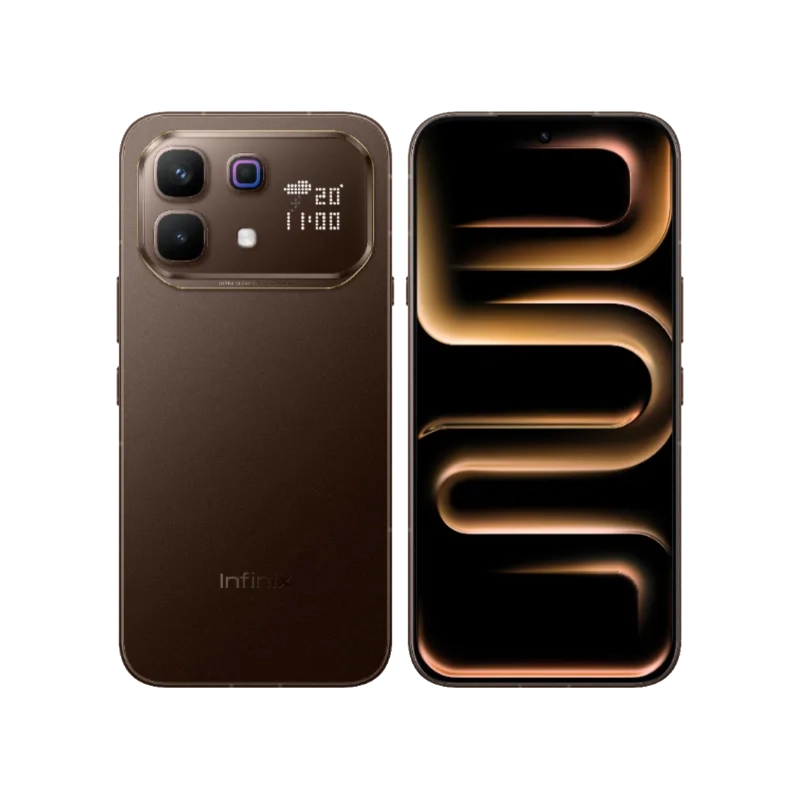
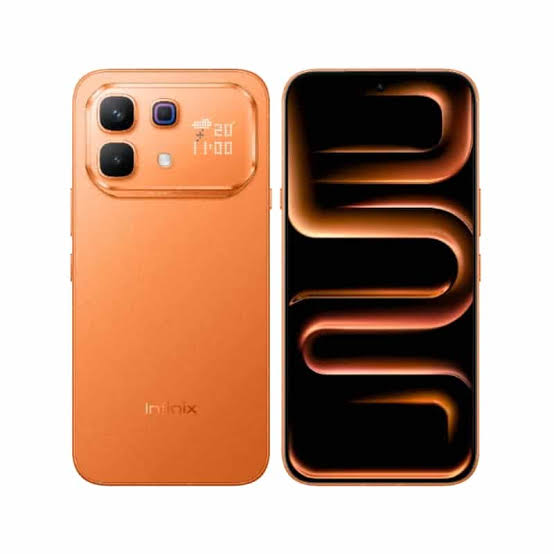
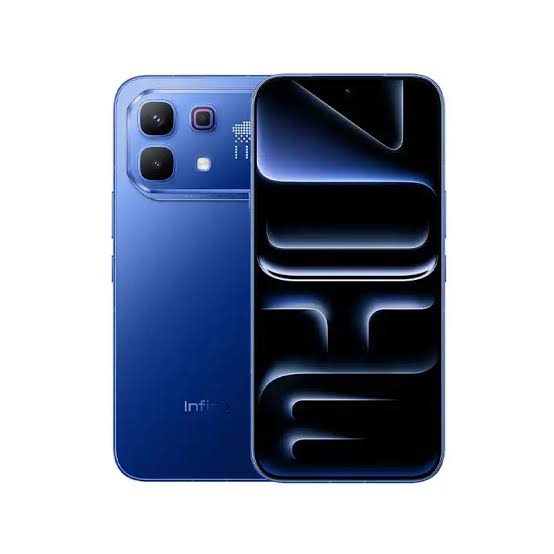

Infinix Note 60 Pro
4K video, 90W wired and 30W wireless charging, a 4,500 nit display and JBL-tuned audio, the best value video phone in the catalogue.
Key Features and Specifications
- Display: 6.78-inch AMOLED, 1208 x 2644 pixels, 19.5:9 ratio, about 429 ppi
- Chipset: Qualcomm Snapdragon 7s Gen 4 (4 nm)
- Memory and Storage: 128GB with 8GB RAM
- Rear Camera: 50MP wide, f/1.6, 27mm, 1/1.95 inch, 0.8 micron, PDAF from 9cm, OIS
- Video Recording: 4K at 30fps, rear camera
Please Note: We do NOT do Lipa Pole Pole. Thank you
Infinix Note 60 Pro
The Infinix Note 60 Pro is available at City Hub Electronics, Nairobi. It records 4K, charges at 90W wired and 30W wireless, reaches 4,500 nits peak brightness and carries JBL-tuned stereo speakers. For a creator on a budget who shoots video rather than stills, this is the strongest value proposition in the catalogue.
Camera
The main camera is a 50MP wide at f/1.6 and 27mm on a 1/1.95 inch sensor with 0.8 micron pixels, with phase detection autofocus from 9cm to infinity and optical image stabilisation. The f/1.6 aperture is the widest in this price bracket and gathers noticeably more light than the f/1.8 lenses it competes against.
The autofocus range starting at 9cm is worth calling out. It means the main camera doubles as a close-focus lens for product detail and texture work without switching to a lower-quality macro sensor.
The second lens is an 8MP ultrawide at f/2.2 and 15mm covering a 112 degree field on a 1/4.0 inch sensor. It is a small sensor and will show its limits in low light, so treat it as a daylight and wide-scene lens.
There is no telephoto lens, so reach beyond the wide is digital crop. Within the Tecno range, the Camon 50 Pro offers a 50MP 3x optical telephoto instead, which is the honest trade to explain to a customer choosing between them: optical zoom and better stills, or 4K video and far faster charging.
A 13MP f/2.2 selfie camera at 24mm handles front-facing work, and it records 4K, which matches the rear camera in resolution.
Video Recording
Resolutions and Frame Rates
The rear camera records 4K at 30fps and 1080p at 30, 60 and 120fps. The 120fps mode gives a 4x conform against a 30fps timeline for slow motion inserts.
The front camera also records 4K at 30fps, plus 1080p at 30 and 60fps. Front-camera 4K is uncommon at this price and matters for creators who shoot pieces to camera, because it removes the usual quality drop when cutting between rear and front footage.
4K capture is the specification that separates this phone from the Tecno Camon 50 and Camon 50 Pro, which are both capped at 1080p 30fps. If a customer is choosing on video capability alone, this is the answer.
Stabilisation
Optical image stabilisation is fitted to the 50MP main camera. The 8MP ultrawide relies on electronic correction only, so handheld ultrawide footage benefits from a steadier hand or a small gimbal.
Because capture runs at 4K, there is real crop headroom for stabilising and reframing in post while still delivering a clean 1080p master. That reframing reserve is the practical advantage 4K brings at this level, more so than 4K delivery itself.
Colour and Dynamic Range
The display is where this phone quietly outperforms its class: a 6.78-inch AMOLED with 700 nits typical, 1,600 nits high brightness mode and 4,500 nits peak, with Ultra HDR support. Independent testing measured close to 1,700 nits in practice.
That brightness matters directly for shooting. Judging exposure and focus on a phone screen in direct Nairobi sun is the most common practical problem in outdoor mobile video work, and a panel this bright largely solves it.
Recording is a conventional 8-bit pipeline with no 10-bit or log option, so grading latitude is limited. Set exposure carefully at capture.
Power
The phone ships with either a 6,000 mAh or a 6,500 mAh battery depending on the variant, and independent testing returned an active use score above 16 hours, which is among the strongest results at any price.
Charging is the standout: 90W wired reaches 50 percent in about 16 minutes and a full charge in roughly 41 minutes on the 6,500 mAh version, or 50 percent in 14 minutes and full in 35 minutes on the 6,000 mAh version. This is faster than any flagship in the catalogue.
Wireless charging runs at 30W, which is faster than the wireless speeds on most flagship phones. There is also 7.5W reverse wired and 5W reverse wireless output, plus bypass charging that draws power directly from the cable during gaming or navigation instead of cycling the battery, reducing heat during long sessions.
Confirm with the supplier which battery variant is in the consignment, since the two versions charge at measurably different rates.
Storage
Three configurations are offered: 128GB with 8GB of RAM, 256GB with 8GB of RAM, and 256GB with 12GB of RAM, on UFS 2.2. There is no microSD card slot.
UFS 2.2 is slower than the UFS 4.x used in flagships, and it is the clearest cost saving in the specification sheet. It is sufficient for 4K 30fps recording, but sustained heavy write loads and large file transfers will feel slower.
Because there is no card slot and 4K consumes space quickly, 256GB is the sensible working configuration for anyone shooting video regularly. 128GB fills fast at 4K.
Editing
XOS 16 runs on Android 16 with up to three major Android upgrades. As with the Tecno models, this is a shorter support window than the top of the market and should be stated honestly to customers weighing a long hold.
The Snapdragon 7s Gen 4 on a 4 nm process with an Adreno 810 GPU is meaningfully more capable than the Helio G200 in the Camon 50 range, which shows in editing responsiveness as much as in gaming.
The bright 144Hz AMOLED with 2304Hz PWM dimming is a comfortable panel for extended editing sessions. High-frequency PWM dimming reduces the eye strain some people experience from OLED flicker at low brightness, which is relevant if you edit at night.
Audio
The stereo speakers are tuned by JBL, and independent testing rated the output as very good. For a store carrying the JBL audio line, that is a natural cross-sell conversation rather than a stretch.
The phone supports 24-bit 192kHz Hi-Res audio and Hi-Res wireless audio, so it does justice to good wireless headphones as well as wired monitoring through a USB-C DAC.
There is no 3.5mm jack. External microphones connect over USB-C 2.0 with OTG support. As with all phones at this level, a wireless lavalier or a shotgun microphone is the single biggest upgrade to dialogue quality.
Design and Build
The Note 60 Pro measures 162.4 x 77.2 x 7.4 mm and weighs 201.7 g. The front is Corning Gorilla Glass 7i over an aluminium frame with a glass back, which is a more substantial construction than the price suggests.
The back carries an RGB notification light and an active matrix display, a design feature rather than a functional one but a distinctive point on the shelf.
Ingress protection is IP64: dust tight and resistant to water splashes only. This is the weakest specification on the phone and the clearest gap against the Tecno Camon 50 range, which is rated IP68 and IP69K. For customers shooting near water or in heavy rain, the Tecno models are better protected.
The display is a 6.78-inch AMOLED at 1208 x 2644 in a 19.5:9 ratio, roughly 429 ppi, at 144Hz with 2304Hz PWM dimming, Ultra HDR support and Gorilla Glass 7i protection.
Unusually, the sensor array includes heart rate and SpO2 sensors alongside the standard set. Colour options are Mist Titanium, Deep Ocean Blue, Solar Orange, Mocha Brown, Torino Black, Frost Silver and Pininfarina Black.
Specifications
| Specification | Infinix Note 60 Pro |
|---|---|
| Display |
|
| Chipset |
|
| Memory and Storage |
|
| Rear Camera |
|
| Video Recording |
|
| Front Camera |
|
| Battery and Charging |
|
| Operating System |
|
| Connectivity |
|
| Build and Protection |
|
| Colours |
|
Buy the Infinix Note 60 Pro at City Hub Electronics.
| Storage |
8GB/128GB ,8GB/256GB ,12GB/256GB |
|---|