

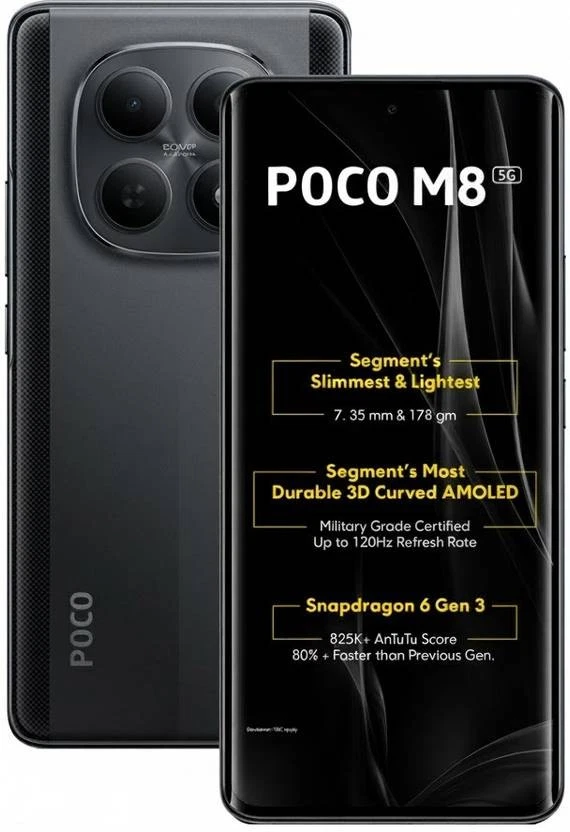
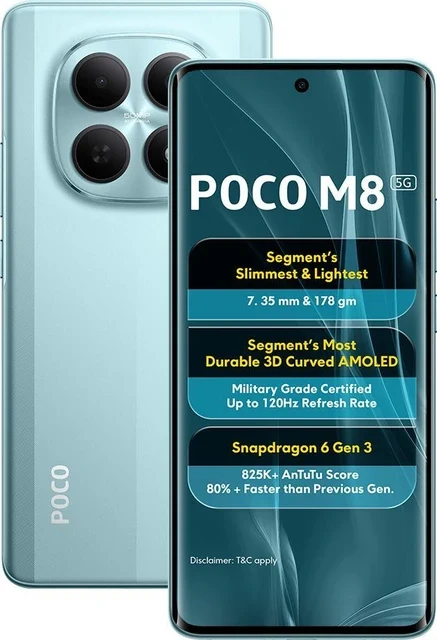

Poco M8 5G
KSh 35,500.00
A 6.77-inch 3,200 nit AMOLED, IP66 and MIL-STD-810 durability, expandable storage and four years of Android updates, at 178 g.
Key Features and Specifications
- Display: 6.77-inch AMOLED, 1080 x 2392 pixels, 19.93:9 ratio, about 388 ppi
- Chipset: Qualcomm Snapdragon 6 Gen 3 (4 nm)
- Memory and Storage: 128GB with 6GB RAM
- Rear Camera: 50MP wide, f/1.8, Light Fusion 400, 1/2.88 inch, 0.61 micron, PDAF
- Video Recording: 4K at 30fps, rear camera
Please Note: We do NOT do Lipa Pole Pole. Thank you
Poco M8 5G
The Poco M8 5G is available at City Hub Electronics, Nairobi. It is a budget phone that spends its money in unusual places: a 3,200 nit AMOLED, IP66 protection with MIL-STD-810 certification and drop resistance to 1.7 metres, a microSD slot, and four major Android upgrades. The camera is where the savings were made, and the sections below set out exactly where.
Camera
The rear camera is a 50MP wide at f/1.8 using the Light Fusion 400 sensor at 1/2.88 inch with 0.61 micron pixels and phase detection autofocus. It supports 2x in-sensor zoom, which crops into the sensor rather than using a second lens.
The second rear lens is an auxiliary depth unit. It contributes to portrait mode separation but does not produce images of its own, so this is effectively a single-camera phone.
There is no ultrawide lens. This is the clearest difference between the Poco M8 and its close sibling the Redmi Note 15 5G, which carries both a 108MP main sensor and an ultrawide. If wide interiors, architecture or tight-space work matter to you, that gap is worth knowing before you buy rather than after.
There is also no optical image stabilisation. Stabilisation is electronic only, which shows up most in low light and in handheld video.
The front camera is a 20MP f/2.2 unit on a 1/4.0 inch sensor. For a phone at this level it is a reasonable selfie camera, and the 3,200 nit display makes framing straightforward outdoors.
Video Recording
Resolutions and Frame Rates
The rear camera records 4K at 30fps and 1080p at 30 and 60fps. The front camera records 1080p at 30 and 60fps.
4K at 30fps is the useful headline here, and it is more than the Tecno Camon 50 range manages at a similar level, where capture is capped at 1080p. What the Poco M8 does not offer is 4K at 60fps, so smooth motion and slow motion conforms are limited to 1080p.
For a creator, the practical read is this: the M8 is a capable second camera and a strong first phone for someone starting out in short-form video. It is not a primary capture device for client work, mostly because of the missing stabilisation rather than the resolution.
Stabilisation
There is no optical image stabilisation on this phone. Video relies on electronic stabilisation, which corrects by cropping into the frame and works reasonably for gentle handheld movement but struggles with walking shots.
If you intend to shoot moving footage on this phone regularly, budget for a small gimbal. It is a far more effective upgrade than paying up a storage tier.
Colour and Dynamic Range
The 6.77-inch AMOLED supports HDR playback with 12-bit colour depth, 800 nits typical and 3,200 nits peak brightness. That peak figure is the standout specification on the whole phone and is well above what this price bracket normally delivers.
It matters directly for shooting outdoors. Judging exposure on a dim screen in direct sun is the most common practical problem in mobile video, and this panel largely removes it.
Recording is a conventional 8-bit pipeline with no 10-bit or log option, so get exposure and white balance right at capture rather than planning to fix them in a grade.
Power
A 5,520 mAh silicon carbon battery powers the M8. Silicon carbon chemistry is what allows this capacity in a body only 7.4mm thick and 178 g, which is genuinely slim for a phone in this class.
Wired charging runs at 45W. Reverse wired charging at 18W lets the phone top up earbuds or a small accessory in the field.
There is no wireless charging, which is expected at this level. Between the efficient 4 nm Snapdragon 6 Gen 3 and a 1080p-heavy usage pattern, day-long endurance is comfortable.
Storage
Four configurations are offered: 128GB with 6GB of RAM, and 128GB, 256GB or 512GB with 8GB of RAM, all on UFS 2.2.
Crucially, this phone has a microSDXC card slot, which almost nothing else in the recent catalogue does. It uses the shared SIM slot, so you choose between a second SIM and expandable storage.
That card slot changes the buying advice. Rather than paying up to 512GB internally, the 128GB or 256GB model plus a large microSD card is usually better value, particularly for someone storing video and photos rather than installing large games. UFS 2.2 is slow by flagship standards but adequate for 4K 30fps capture.
Editing
The Snapdragon 6 Gen 3 on a 4 nm process with an Adreno 710 GPU handles editing apps at this level competently, though large 4K timelines will feel slow compared with the Poco X8 Pro.
The phone shipped on Android 15 with HyperOS 2, with an update to HyperOS 3 on Android 16 promised. Poco commits to four major Android upgrades and six years of security updates, which is an unusually long support window at this price and ends the device on Android 19.
Google Gemini and Circle to Search are included, and the bright display makes reviewing and cropping stills comfortable.
Audio
Stereo speakers with Dolby Atmos handle playback, and the phone supports 24-bit 192kHz Hi-Res audio, which is a real specification rather than a marketing line at this level.
There is no 3.5mm jack. External microphones connect over USB-C 2.0 with OTG support. The port is USB 2.0, so offloading a large shoot to a computer is slow and a card reader is often faster.
An infrared port is included, which is useful for controlling TVs and air conditioners and has largely disappeared from more expensive phones.
Design and Build
The Poco M8 measures 164.0 x 75.4 x 7.4 mm and weighs 178 g. Both the body and frame are plastic, which is the honest trade at this price and also part of why it survives being dropped.
Durability is where this phone genuinely outperforms its class. It is rated IP66 against dust and high pressure water jets, carries MIL-STD-810 certification for heat, dust and shock, and is drop resistant up to 1.7 metres. European units carry an IP65 rating instead.
The display is a 6.77-inch AMOLED at 1080 x 2392 in a 19.93:9 ratio, roughly 388 ppi, running at 120Hz with 3840Hz PWM dimming, HDR support and 12-bit colour. High frequency PWM dimming reduces the eye strain some people experience from OLED flicker at low brightness.
One point of taste worth raising with customers: the panel is curved at the edges. Some buyers strongly prefer a flat screen at this price, and curved glass is more awkward to fit a screen protector to.
Colour options are Carbon Black, Glacial Blue and Frost Silver, listed by some sources as Black, Green and Silver depending on market.
Specifications
| Specification | Poco M8 5G |
|---|---|
| Display |
|
| Chipset |
|
| Memory and Storage |
|
| Rear Camera |
|
| Video Recording |
|
| Front Camera |
|
| Battery and Charging |
|
| Operating System |
|
| Connectivity |
|
| Build and Protection |
|
| Colours |
|
Buy the Poco M8 5G at City Hub Electronics.